 rss
Riemann Solver
I made a Riemann solver. I then ran the Riemann solver to reproduce tests 1, 2, 4, and 5 from Table 4.1 of Riemann Solvers and Numerical Methods for Fluid Dynamics by Toro. Here are the results, which appear to agree with the corresponding figures in chapter 4.3.3.


COMMON ENVELOPE SIMULATIONS
Tentative plan for new CE runs
All runs will use AGB setup from C+2020
| Run | EOS | Run ID | Progress | Remaining cost | Potential impact | Comments | Relevant papers |
|---|---|---|---|---|---|---|---|
| equal mass particles | gamma=5/3 | 263 | ran up to 170 d | low | medium | To explain drag force | Escala+2004 |
| ~0.08 Msun companion | gamma=5/3 | N/A | N/A | medium-high | medium | How much expansion? | Kramer+2020, Observations by Xu+2021 submitted |
| EOS+CE | MESA | N/A | N/A | medium-high | high | Compare with C+2020 gamma=5/3 run | Sand+2020 |
| EOS+CE no rec energy | Modified MESA | N/A | N/A | medium-high | high | See Xsede proposal |
COMMON ENVELOPE SIMULATIONS
Evolved binary runs planned/ongoing
Actively running now = bold
| Run | Run ID | Progress | Remaining cost | Potential impact | Energy conservation |
|---|---|---|---|---|---|
| EOS+CE (RGB) | 248,252,253 | runs but hangs | medium | high | |
| RLOF+CE (RGB) | 195 | ran up to 47 d | medium | medium | not yet checked |
| RLOF+CE (AGB) | 264,265,266 | runs but hangs | high | medium | |
| CE equal mass particles (AGB) | 263 | ran up to 170 d | low | medium | not yet checked |
| CE low mass companion (AGB) | 259 | ran up to 250 d | none | high | 4% increase |
| CE (AGB), 4x higher resolution | 267 | ran up to 0.7 d | high | high | not yet checked |
| Wind+accretion with low mass companion | N/A | not started | low? | medium | Z.Chen+2017 setup |
Runs
- Continued running Run 263 (equal particle mass AGB run). Now up to 170 days.
- Next step is to plot separation and energy conservation, before resuming run
- Goal is to explain the drag force at late times. Steps are
- test the Escala+2004 model using this run (263), and then
- try to generalize it to the unequal particle mass case, and compare with published AGB run (183)
- Started Run 267. Like published run (183) but max resolution is 4x higher.
- It ran up to 0.7 days (3.0 frames) in 48 hours on 64 skx nodes; each chombo is 212 GB
- Next step is to plot a(t), density slices, and energy conservation.
- How does energy conservation compare to Run 183? If much better, then perhaps worth continuing.
- Goal would be to run for 3 times as long as Run 183 (also serves as a convergence study).
Analytical model for WD 1856+534 system
- First key new idea is that planet 1 was actually a brown dwarf (maybe 50 M_J, i.e. about 0.05 Msun).
- Not massive enough to eject the envelope during inspiral
- But massive enough to expand the star, which engulfs planet 2 (this could happen at this stage or possibly later on)
- BD tidally disrupts and forms disk, which accretes and also spreads radially.
- Planet 2 inspirals and encounters disk.
- Accretion of disk material gradually releases potential energy, eventually resulting in envelope ejection.
- Second new idea is that planet 2 enters the disk left over from the tidal disruption of planet 1 and migrates, coming to rest near its present position. In this version of the model, there would be no need for planet 2 to eject any of the envelope (its ejection of <~1 % had always seemed like fine-tuning to me)
- Is the disk spreading fast enough to spread out to the current separation of planet 2 (4 au) from disruption separation of planet 1 (~0.4 au)?
- What governs the migration?
- Is it type II migration (gap formation)?
- Is the disk dense enough to pull the planet with it as it spreads viscously?
- Does the planet still experience drag with the envelope while it is embedded within the disk?
- Is the drag from dynamical friction or is it hydrodynamic, or are both important?
- Assuming inward migration owing to drag balances outward migration owing to disc spreading, at what orbital separation does the planet come to rest?
- Does it agree with the observed separation?
- Or can we used the observed separation to constrain its mass?
Planetary winds
- Chatted with Eric about his analytic model
- Had the idea that turbulence in the wake behind planet might produce random motions with velocity ~v_orb~150 km/s
- However, ambient stellar wind material is ionized so turbulence needs to be in neutral planet wind gas
- Turbulence would be driven by K-H instability.
- Using equation 2 of Hillier et al. 2020, I estimate that mixing leads to rms turbulent velocities of ~30 km/s, assuming a density contrast of 100 between planetary wind material and ambient stellar wind material. So unlikely to work.
- One difficulty with the magnetic field model is that the radial field is too small near the orbital plane if one assumes a dipole geometry.
- However, it seems like beyond about 2 solar radii, the sun's field is almost radial (and curves into a Parker spiral further out) - see Fig. 1 of Owens+Forsyth 2013.
- According to that last paper, the transition to radial occurs at the source surface, at a few solar radii. The planet is at 0.047 au ~= 10 Rsun, so a radial field is probably a reasonable (though somewhat optimistic) assumption.
- See also this paper Eric sent which could be used to estimate the field strength in the stellar wind at the planet: Wang+Sheeley 2002.
Upcoming meetings
- CE meeting Tues July 20 to discuss runs
- WD planet meeting Tues July 27
Job interview
- July 28 (requires quite a bit of prep)
Vacation
- July 30- back on Aug 9
Dust in AstroBEAR - Update 2021/07/16
Progress:
For a while now I've been working on a new setup based on papers investigating dust destruction in so-called "windblown bubbles" around SNe. Most studies use several codes for this (one to simulate the immediate explosion aftermath to generate the shock structure, one to simulate the expansion of remnant for a few decades, one to simulate the expansion for several thousand years after & interaction with ISM). I'm trying to do the whole within one simulation. The most crucial part seems to be reproducing the correct shock speeds and structures. I think I'm pretty close now but will probably increase the initial velocity a bit to better match observations of Cas A. There are also some cosmetical issues (instabilities forming in the CSM where AMR levels change) plus issues at the boundaries. Will re-introduce dust once that's done.
Here's a gif of the current simulation going to almost 2k years: gif
And the individual outputs: 1, 2, 3, 4, 5, 6, 7, 8, 9, 10, 11, 12, 13, 14, 15, 16, 17, 18, 19, 20.
Two questions about this:
- are the instabilities developing along the y-axis caused by numerics?
- I'm getting string reflections from the centre which I'm not sure are physical, any way to suppress that?
CEJet - figures and movies
New fiducial run with accretion onto the companion, run021 (J4)
click on each image to play a .gif file
Jet tracer density rendered in pseudocolor with ramp transparency
The labels 0 and 1 mark the center of primary and secondary stars respectively. (Please ignore the time slider in the movies.)
Left: Day 0-14, in lab frame looking down towards the orbital plane. Middle: Day 15-40, in lab frame looking down towards the orbital plane (notice the scale is smaller compare to the left one) Right: Day 0-40, in lab frame side view looking at the x-z plane (this view includes the simulation's outer boundary as the gray frame around it.).


Pseudocolor jet tracer density, compare two cases with accretion (J4 and J5)
Viewed in slices with perspective from the primary to the secondary. The green circle marks softening radius around the companion particle.
Left: J4, the new fiducial model with Jet Mdot = 2e-3 Msun/yr. Middle: J5, 10 times the Jet Mdot, other setups are the same as J4. Both simulations have the companion accreting from their environment.
Right: J1, Jet without accretion onto the companion.


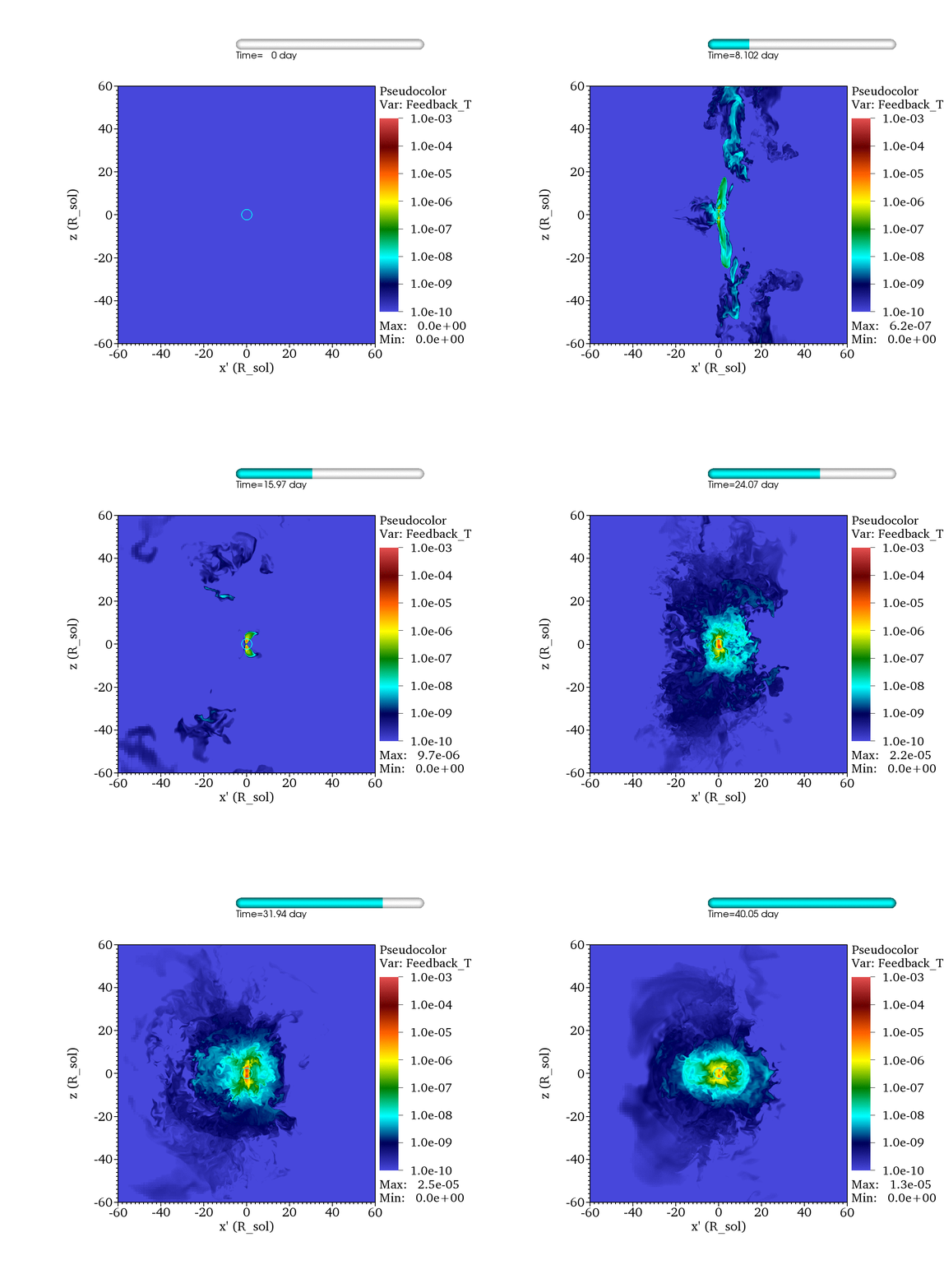
Jets reappear at late time
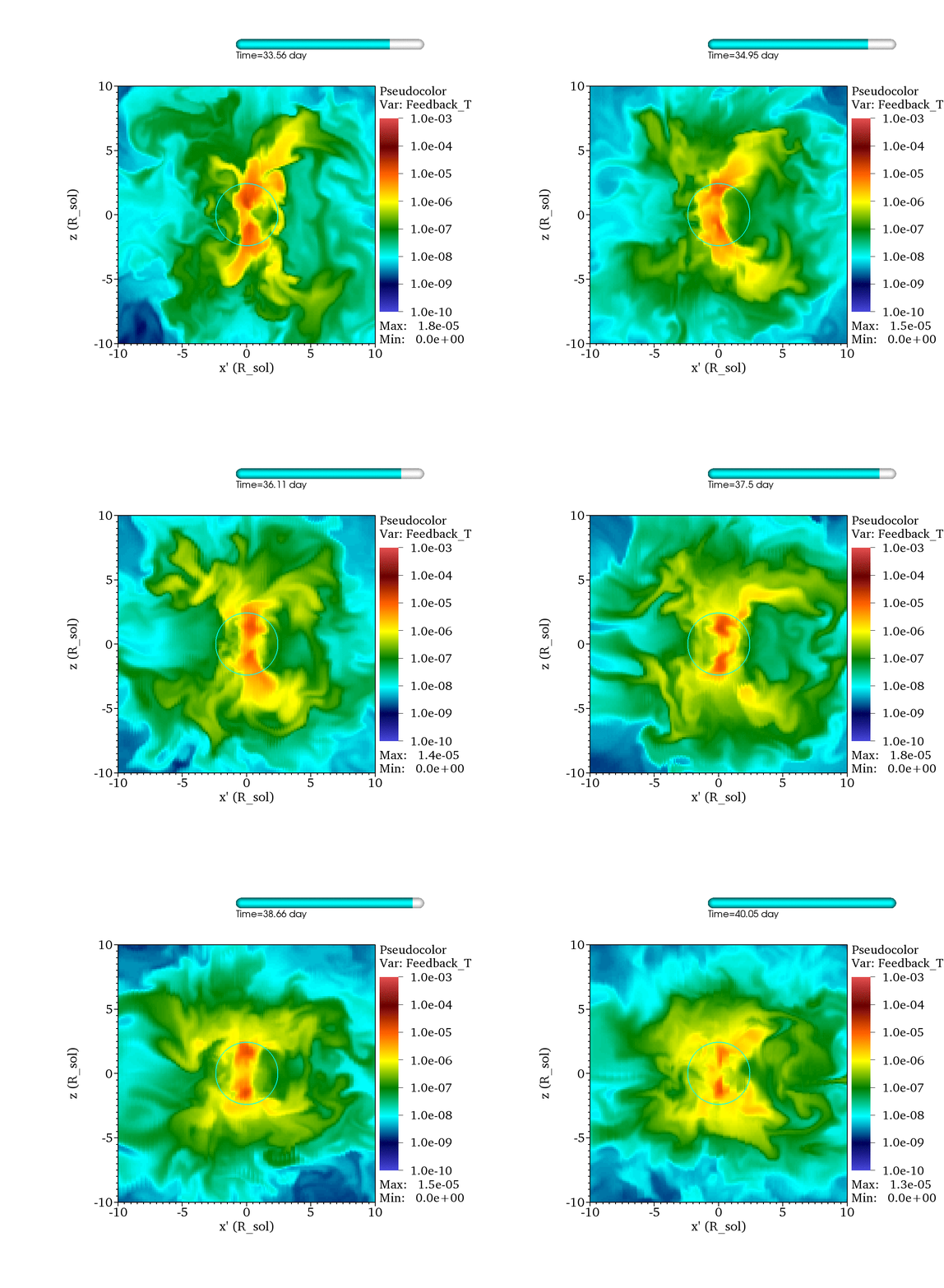
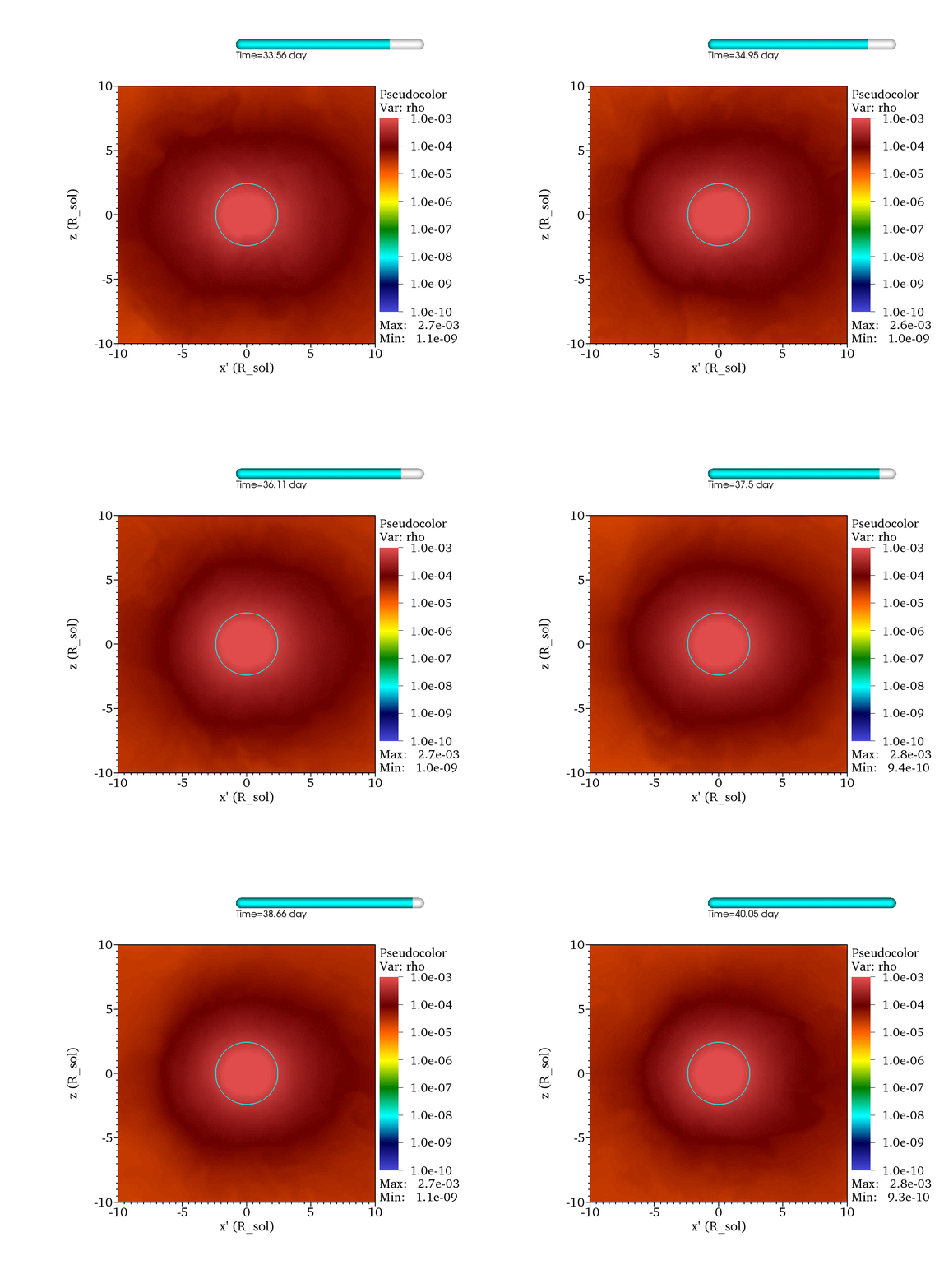
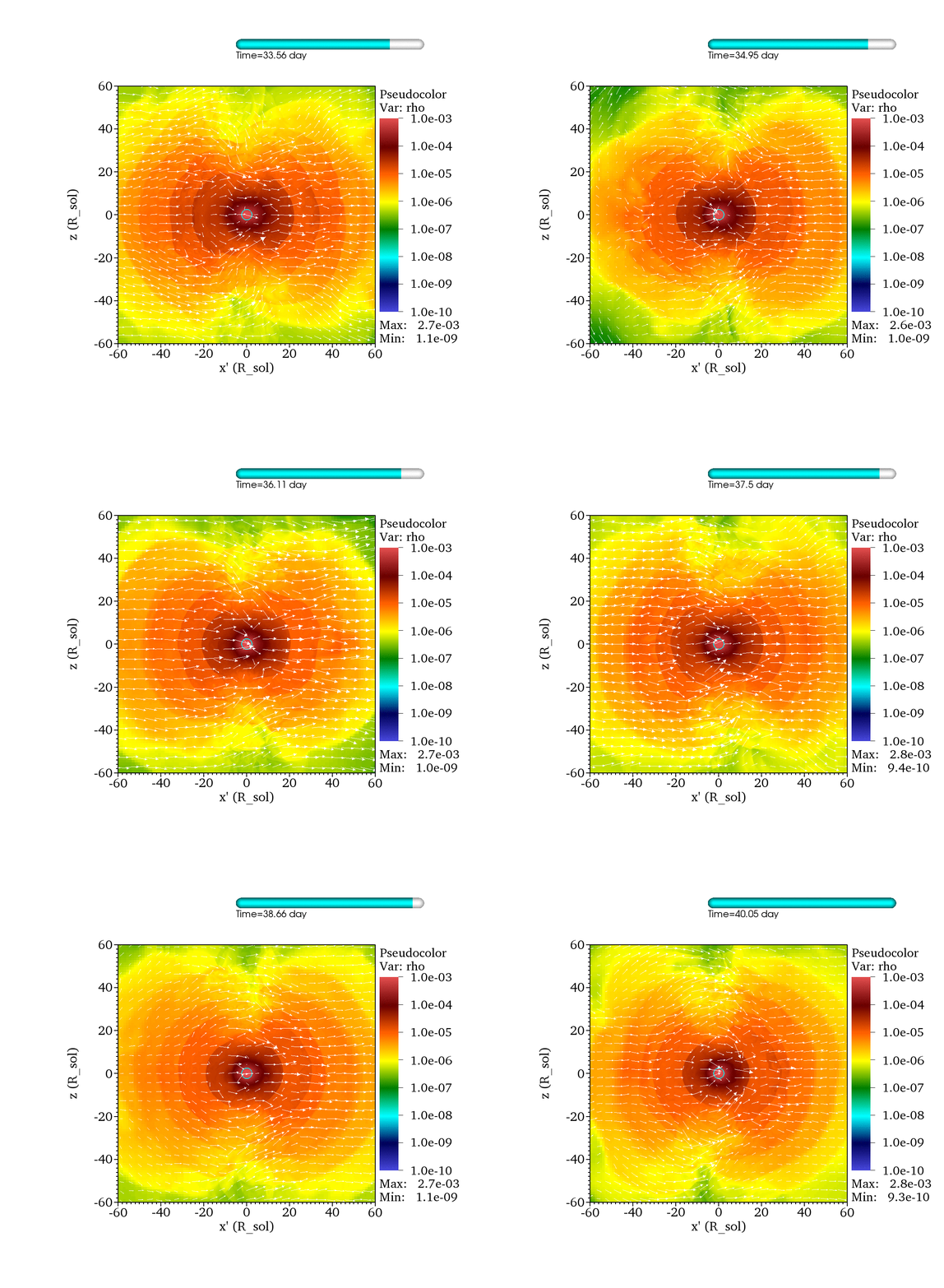
Compare the time evolution in jet density (top row) and total gas density (bottom row). The view is from core of the primary looking at the companion, zoomed around the particle (softening radius marked by the green circle for reference).
Left: J4, P2 accretes from the environment, Jet Mdot = 2e-3 Msun/yr Middle: J5, P2 accretes from the environment, Jet Mdot = 20e-3 Msun/yr Right: J1, no accretion, P2 loses mass to supply the jets.






A repository of plots for all the runs
Fermi Project Update July 2021
Parameter Sweep: Periodic Box Model


COMMON ENVELOPE SIMULATIONS
Work in progress
- CE with low-mass companions
- More work to constrain the origin of the WD 1856+534 system
- We are now using MESA models to constrain our model
- For a given WD mass, what scenario is possible?
- Mass of companion — planet, brown dwarf, or low-mass M-dwarf?
- How common would BDs and low-mass M-dwarfs be? Soszy\'{n}ski+2021
- Simulations that could help to understand this:
- How common would BDs and low-mass M-dwarfs be? Soszy\'{n}ski+2021
- Did WD 1856+534 b play a role in ejecting the envelope or was it passive?
- Did WD 1856+534 b get engulfed during the plunge-in of planet 1 or after the tidal disruption of planet 1?
- Mass of companion — planet, brown dwarf, or low-mass M-dwarf?
- More work to constrain the origin of the WD 1856+534 system
Evolved binary runs planned/ongoing
| Run | Run ID | Progress | Remaining cost | Potential impact | Energy conservation |
|---|---|---|---|---|---|
| EOS+CE (RGB) | 248,252,253 | runs but hangs | medium | high | |
| RLOF+CE (RGB) | 195 | ran up to 47 d | medium | medium | ? |
| RLOF+CE (AGB) | 264,265,266 | runs but hangs | high | medium | |
| CE equal mass particles (AGB) | 263 | ran up to 100 d | low | medium | ? |
| CE low mass companion (AGB) | 259 | ran up to 250 d | none | high | 4% increase |
| CE high resolution (AGB) | N/A | not started | high | high | N/A |
| Wind+accretion with low mass companion | N/A | not started | low? | medium | Z.Chen+2017 setup |
